
Lost in Space
What the hero's journey in science fiction teaches us about who we are

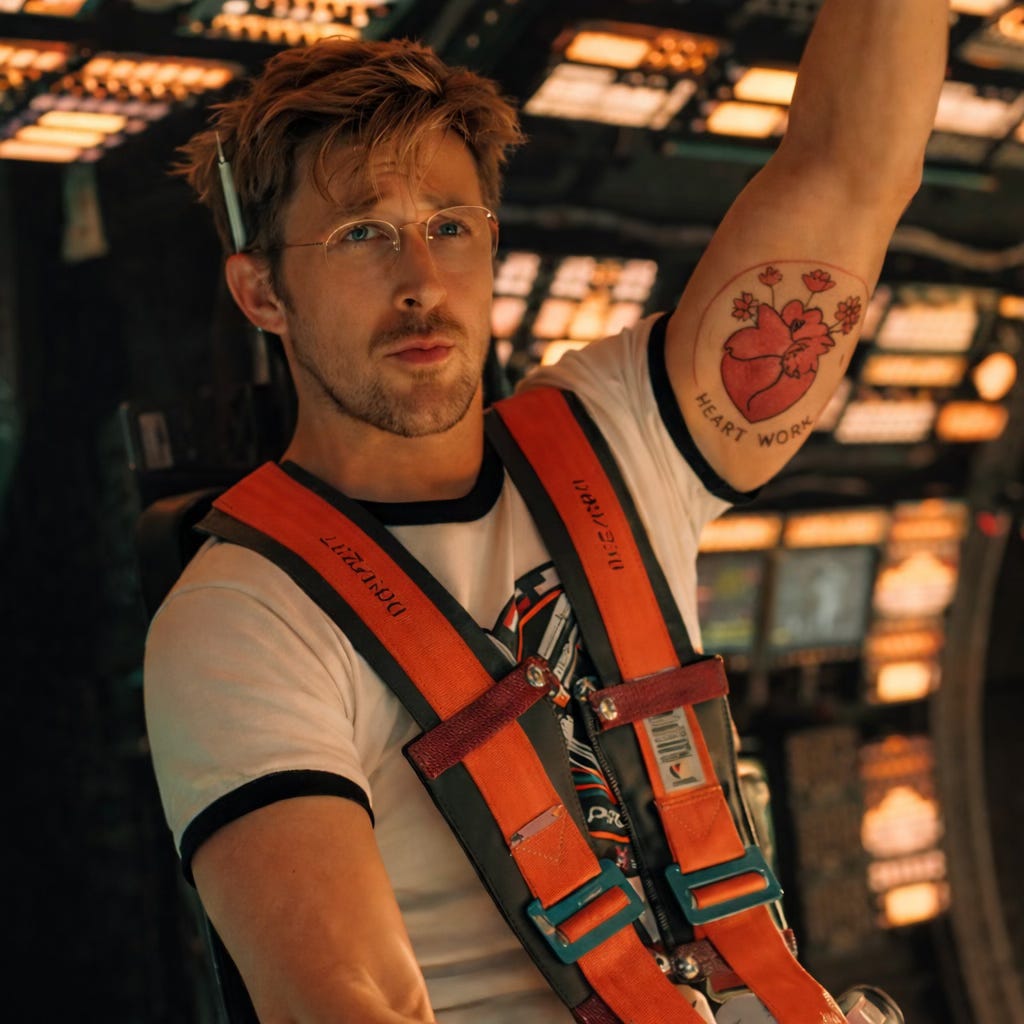
Never before seen, definitely not AI generated, super duper realistic photo of Ryan Gosling on the set of Project Hail Mary revealing himself as the heart worker he is.
People who study the human condition have this belief that those who believe in and make decisions based on astrology, vibes, energy are enticed by that form of data because they have experienced trauma.
The idea is that those who have faced unpredictable, nonsensical, intense events (like being violated, living in a war zone, growing up with emotionally unstable parents) don’t have the same trust in or believe in the reliability of so called fact as do people who grew up in lives that were stable and predictable.
If you learned the rules but then stuff happened and suddenly “the rules” seemed as make believe as they are, it makes sense, doesn’t it, to seek out alternate forms of data?
When my brother died, life felt unfamiliar and strange. It was like living in a horror movie. I’d scrape myself together to get groceries, and while staring at yogurt in the dairy aisle, I’d suddenly remember that Luke died, that I no longer had an older brother, that I was only standing in the grocery store at 2pm in dirty sweatpants because I couldn’t even be upright enough to go to work. This would prompt a what the FUCK to burst out of my mouth. Naturally. The theories of grief and care plans for bereavement that I proudly taught to students and used in care encounters in my practice seemed embarrassingly limited. Had I really been going around handing out pamphlets??
I didn’t know where healing would be found, but let me tell you: earth wasn’t it. Even language somehow didn’t work. People always wonder what do I say?? to someone in a hard time but I think the answer doesn’t even matter because language doesn’t really exist in the place the person who is super hardcore going through something is temporarily relocated.
I shifted my focus. The earthly world of thoughts and prayers and condolences had no meaning to me. Instead of fighting it or trying to outsmart it, I surrendered.
Both to feel close to my brother and to consider an alternate source of data for my confused state, I started reading all the weird science fiction and fact books Luke tried to make me read while he was alive. In those books and stories, I met protagonists on journeys, so many journeys, where they found themselves in unlikely scenarios, were plunged onto a path they didn’t want to be on, went on a few side quests and eventually met a wise sage, or two, that would help them launch themselves into the final stage of their becoming. The hero’s journey.
I love the framework of the hero’s journey. A tidy, predictable and yet constantly relatable template for what humans go through when they go through anything.
We are all on a hero’s journey of some kind.
Some of us are at the start, wondering how on earth we landed in whatever situation we’re in (a recent break up, a job loss, a tough conversation with a parent, a change in bodily function, a diagnosis).
Some of us are in the deep dark woods, grappling with the monsters that live in there (what am I doing with my life? how do I make a change if I’m too scared to make a change? will this ever end? will I always have to do so many hard things alone? does anyone understand me?)
Some of us have met a wise sage of some kind - a kind friend with a listening ear, a therapist who knows how to push your thinking deeper, a well written book that feels relatable and adds insight, a retreat where you drop in and connect to spirituality and essence.
Some of us are on the other side, feeling the well that was intense but what a learning experience vibe. A lot of life coaches emerge from this state, actually, so profound is that feeling of I made it that they see it as a professional attribute of some kind. (For some, it is, but not most). This state is blissful, temporary, intended for reflection and gratitude.
I love science fiction, am so enticed by quantum physics and mechanics, and am grateful that the best qualities of those realms actually exist quite reliably in the therapeutic context. To make a living in the realm of the weird is highly satisfying. I think it is my ability to withstand the deep dark woods of my own life (the many versions I was plunged in to) that makes me a good therapist because I’m not afraid of what is happening in there. No way, I know the healing is somewhere inside that space and if the person can give in to that, enlightenment and transformation will occur.
When students or those I supervise ask how to bring depth to their practice, how to shift from templates and meaningless platitudes that clients hate to hear (no one could blame them), the answer always lies in the esoteric, the weird, the woo, the spiritual, the science.
In this issue, I will use the delightful book recently made into a movie, Project Hail Mary, and good old philosophy to look at how identity construction occurs while in the deep dark woods (or, deep space, as the case might be). I’ll share a bit from theory and offer questions for your own self reflection. I will restrain myself from mentioning even once how adorable the science teacher version of Ryan Gosling is (but SERIOUSLY). I will also be careful not to spoil the movie for you, since I really think you should go see it.